
AC Repair vs. Replace in Las Vegas: An Honest Decision Guide
If you’ve owned a home in the Las Vegas valley for more than a few summers, you’ll eventually face the same question every homeowner here faces: this AC is acting up again — do I fix it, or is it time for a new one?
It’s a real decision, and a stressful one. The numbers are big either way, and the wrong call can cost you money for years — in the form of either repeated repairs on a system that’s done, or a premature replacement on a system that had life left.
This guide is meant to help you think through it honestly, not push you in either direction. We’ll cover the rule most pros use, the actual math (which works out differently in Mojave heat than the textbooks suggest), the questions to ask any contractor, and when a $1,500 repair on a 13-year-old rooftop unit really is throwing good money after bad.
We’re Five Star Mechanical — a licensed Las Vegas HVAC and plumbing company. If you want a second opinion on a quote, call 702-550-0380. We’d rather lose the sale by being honest than win it by pushing a replacement you don’t need.
The rule of thumb (and where it breaks)
The classic guideline most HVAC pros use is the $5,000 rule: multiply the cost of the repair by the age of the system in years. If the number is over 5,000, replace. Under, repair.
A $400 capacitor on a 6-year-old system is $2,400 — repair, easy. A $1,500 compressor on a 14-year-old rooftop unit is $21,000 — replace, also easy. It’s the in-between cases where things get hard, and where homeowners get pushed into the wrong decision.
The rule is a starting point, not a verdict. It doesn’t account for refrigerant type, what the rest of the system looks like, what the Mojave climate has done to it, or how long you plan to be in the house. Here’s how we actually think about it.
The five factors that matter more than age alone
1. What’s actually broken
Not all repairs are equal. A capacitor or contactor is a $200–$400 part that’s expected to fail in this climate and easy to swap. A blower or fan motor is mid-range. A compressor or evaporator coil is a completely different conversation — those parts often run half the cost of a new system after labor. If the diagnosis is a compressor on a 12+ year-old unit, the math almost always tilts toward replacement.
2. Refrigerant type
This catches a lot of valley homeowners off guard. If your system still uses R-22 refrigerant (phased out in 2020), and it’s leaking, you’re in trouble. R-22 is no longer manufactured, prices have climbed sharply, and any repair involving refrigerant is expensive and temporary. R-22 systems are also old by definition. Newer systems use R-410A, with the industry now transitioning to R-454B.
If you don’t know which refrigerant your system uses, any honest technician can tell you from the data plate on the outdoor unit.
3. Your power bill — this is the one most people overlook
An aging AC that’s still “working” can quietly cost you hundreds of dollars a summer in extra electricity. Modern high-efficiency systems can pull 30–50% less power for the same cooling. In the Las Vegas valley, where you’re running the AC heavily from May through September and overnight lows often stay in the 80s — meaning the system never really stops — that difference adds up faster than almost anywhere else in the country.
If your summer NV Energy bills have climbed year over year despite similar usage, that’s your system telling you it’s losing efficiency.
4. Rooftop vs. ground-level
This is the factor that makes Las Vegas different from most markets. A huge number of valley homes use rooftop package units rather than split systems, and that changes the math:
- Rooftop units take more sun and heat-soak than ground-level condensers, so they tend to wear out faster — expect 10–14 years here rather than the 15–20 the brochures advertise.
- Repair labor is more expensive on a rooftop unit because everything has to come up via crane or lift.
- When you do replace, the install is more involved — but a new high-efficiency rooftop unit dramatically outperforms a tired one.
If you’ve got a 12+ year-old rooftop package unit needing a significant repair, lean harder toward replacement than the $5,000 rule alone would suggest.
5. How long you plan to stay
A new system is a 15-year investment. If you’re staying 10+ years, the math almost always favors replacement once a system is past 12 years old — especially in this climate. If you’re planning to sell within a year or two, a $1,000 repair to keep things running is reasonable — though Las Vegas buyers in summer absolutely notice an aging AC during inspection.
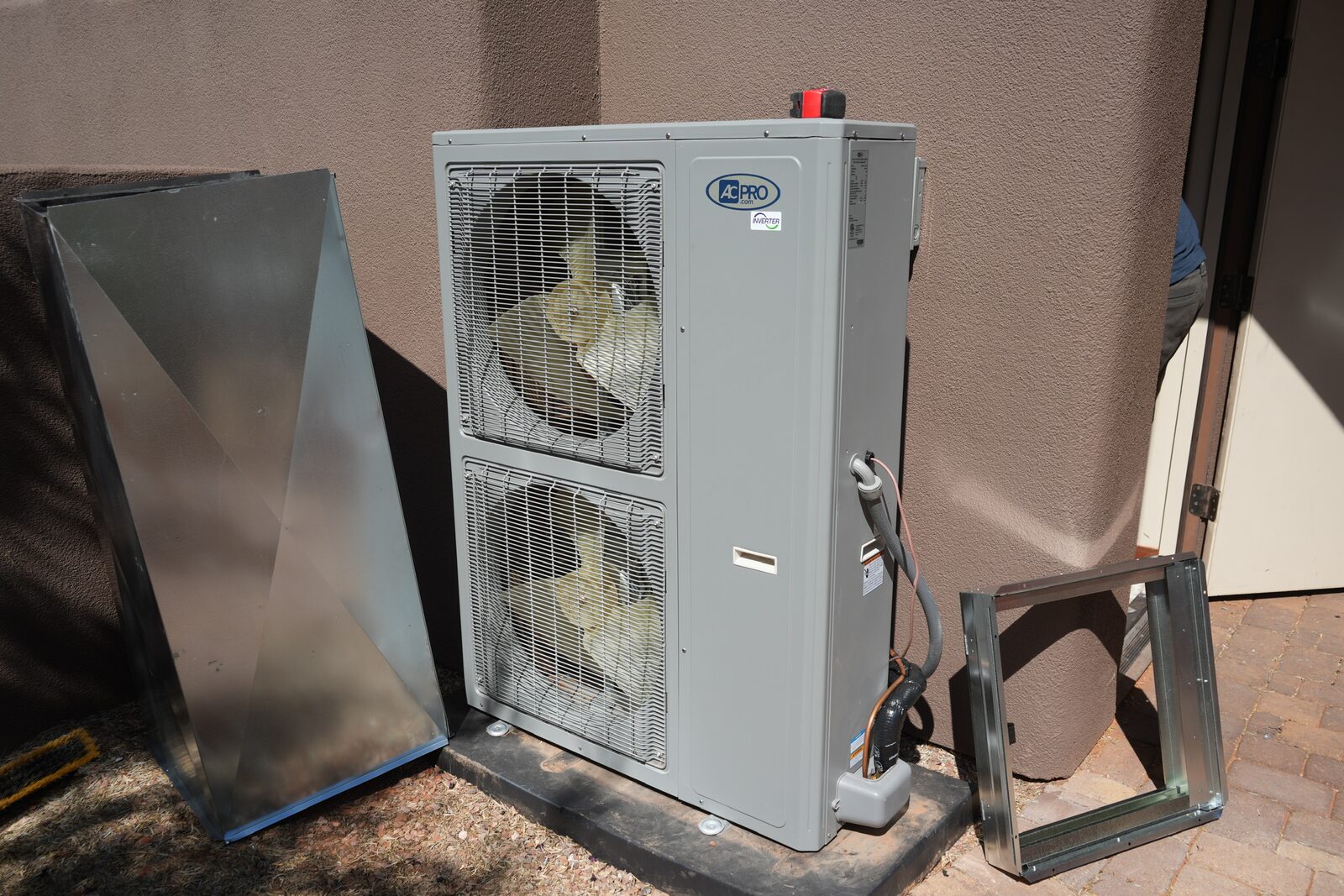
A new inverter system going in — modern high-efficiency equipment can pay back its install cost surprisingly fast in valley summers.
The Las Vegas factor
The Mojave climate accelerates the math on replacement in two specific ways most homeowners underestimate.
First, systems wear out faster here than the brochures suggest. Manufacturers quote 15–20 year lifespans based on average climates. A unit running near full capacity from May through September, with overnight lows in the 80s and valley dust packing into the coils, often hits end-of-life closer to 10–14 years — sooner if it’s on a roof. So if your unit is 13 and someone’s quoting a $1,500 repair, treat that as the second warning shot.
Second, the savings from a high-efficiency replacement compound faster here. In a mild climate a more efficient system might save $300 a year. In the Las Vegas valley, with five months of heavy cooling, the same upgrade can save $800–$1,200 a year. A new system that “costs too much” can pay back in 5–8 years rather than 12.
Questions to ask any contractor who quotes you
Whether the quote is for a repair or a replacement, ask these before signing:
- “What’s actually wrong, in plain English?” If they can’t explain it clearly, that’s a flag.
- “What’s the realistic remaining life on this system if I do this repair?” An honest tech will give you a range.
- “If you were in my shoes, would you do this repair?” Watch the hesitation.
- For replacement quotes: “What size am I getting and how did you size it?” A real load calculation (Manual J) is what you want. “Same size as what’s in there” is what most contractors say, and it’s often wrong — especially if your home has been updated or had a roof or windows redone since the original install.
- “What’s the warranty — parts AND labor?” 10-year parts is standard from manufacturers. The labor warranty is the real signal of how confident the installer is.
- For rooftop installs: “Who’s doing the crane work and is it included?” Hidden crane fees are a common Vegas gotcha.
So when is repair the right call?
- The system is under 10 years old and the failure is a common contained part (capacitor, contactor, fan motor)
- Repair cost is under about 15% of replacement cost
- The system uses R-410A (not R-22) and there are no other warning signs
- Your NV Energy bills haven’t been creeping up
- You don’t plan to be in the house long-term
When replacement is the honest answer
- The system is 12+ years old AND needs a major repair (compressor, coil, multiple components)
- It still uses R-22 refrigerant and has a leak
- You’ve had two or more significant repairs in the last two summers
- Power bills have climbed noticeably year over year
- It’s a rooftop unit past 10 years showing real fatigue
- The unit can’t keep up with the heat anymore even when it’s “working”
How we handle this at Five Star Mechanical
When we come out on an AC call, our default is to repair, not replace — it’s the cheaper outcome for you and a simpler job for us. We’ll tell you when a repair makes sense, and we’ll tell you straight when it doesn’t. We’d rather you trust us with your next call than push a replacement you didn’t need.
If another company has given you a replacement quote and you’re uncertain, we’re happy to come look and give a second opinion — no pressure, no obligation.
Got a repair-or-replace decision to make?
Call us. We’ll come look, give the straight answer, and explain the tradeoffs — no pressure either way.
Call 702-550-0380